The Psychology of Poverty and Its Impact on Mental Health in America
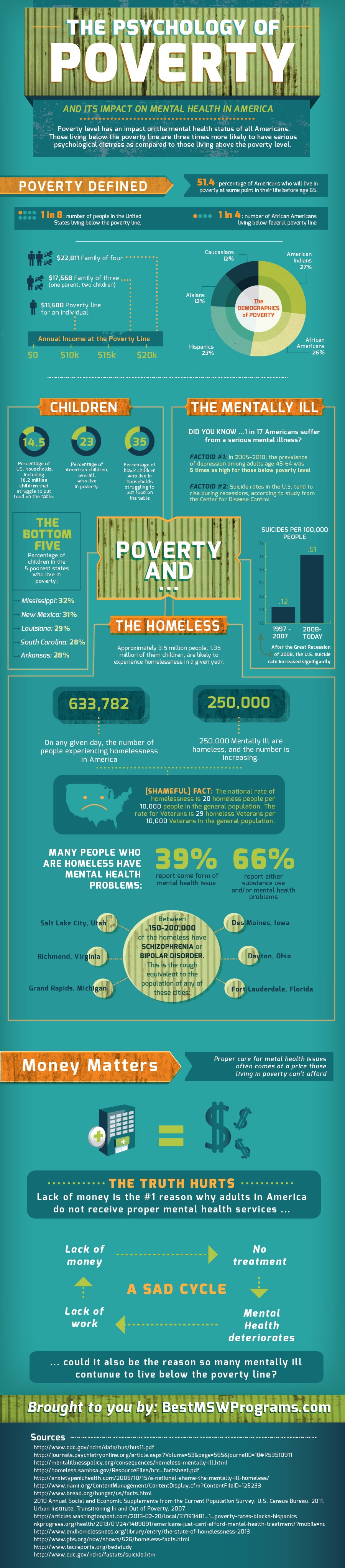
Poverty has an impact on the mental health of all Americans. Those living below the poverty line are three times more likely to have serious psychological distress as compared to those living above the poverty level.
Poverty level:
- $22,811 for family of four
- $17,568 for family of three, one parent, two children
- $11,500 for an individual
- 1 in 8 people in the United States living below the poverty line
- 1 in 4 African Americans living below federal poverty line
The demographics of poverty:
- 27 percent of American Indians live in poverty
- 26 percent ofAfrican Americans
- 23 percent of Hispanics
- 12 percent of Caucasians
- 12 percent of Asians
- 51.4 percent of Americans who will live in poverty at some point in the life, before age 65
Poverty among children:
- 23 percent of American children, overall, who live in poverty
- 14.5 percent of US. Households,including 16.2 million children, struggle to put food on the table
- 35 percent of black children live in households struggling to put food on the table
States with the highest child poverty rates:
Poverty and the mentally ill
26.2 percent of Americans ages 18 and older, or about one in four adults, suffer from a diagnosable mental disorder in a given year. That's 57.7 million people.
Put another way looking at ALL Americans: 6 %: or 1 in 17 suffer from serious mental illnesses.
FACTOID: In 2005-2010, the prevalence of depression among adults, 45-64 was 5 times as high for those below poverty level.
Suicide rates in the U.S. tend to rise during recessions and fall amid economic booms, according to study from the Center for Disease Control.
- 12.4: suicide rate per 100,000 people as of May, 2013
- 11.6: suicide rate in 2008, the date considered the Great Recession
- 22: suicide rate per 100,000 people during the Great Depression, 1932 (an all time high)
The Great Recession, 2008: U.S. suicide rate was increasing by about 0.12 deaths per 100,000 people between 1999 and 2007, but when the recession hit in 2008, the rate began increasing by an average of 0.51 deaths per 100,000 people each year. This jump resulted in about 1,500 additional deaths from suicide each year after 2008.
Poverty and the homeless
The number of homeless Americans is hard to pin down, since homelessness is often a transient state, and due to the conflicting definitions of "homeless." The best approximation is from a study done by the National Law Center on Homelessness and Poverty in 2007, which states that approximately 3.5 million people, 1.35 million of them children, are likely to experience homelessness in a given year. This translates to approximately one percent of the U.S. population experiencing homelessness each year, almost 40 percent of them being children.
633,782: on any given day, the number of people experiencing homelessness in America.
The national rate of homelessness is 20 homeless people per 10,000 people in the general population. The rate for Veterans is 29 homeless Veterans per 10,000 Veterans in the general population.
Many people who are homeless have mental health problems:
- 39% report some form of mental health problems (20-25% meet criteria for serious mental illness).
- 66% report either substance use and/or mental health problems.
Between 150,000 and 200,000 of the homeless have schizophrenia or bipolar disorder. This is the rough equivalent to the population of any of these cities:
- Dayton, Ohio
- Des Moines, Iowa
- Fort Lauderdale, Florida
- Grand Rapids, Michigan
- Providence, Rhode Island
- Richmond, Virginia
- Salt Lake City, Utah
Who are the homeless?
- 39% are non-Hispanic whites (compared to 76% of the general population)
- 42% are African-Americans (compared to 11% of the general population)
- 13% are Hispanic (compared to 9% of the general population)
- 4% are Native-American (compared to 1% of the general population)
- 2% are Asian
Homelessness continues to be a largely urban phenomenon.
- 71% are in central cities
- 21% are in suburbs
- 9% are in rural areas
Why are there so many mentally ill homeless people?
- The plan to transition from mental institution to outpatient care failed
- Most mentally ill homeless people are not being treated
- Community mental health centers are inadequate
- Community mental health centers, where the homeless might receive help, are chronically underfunded, and are often on the budget-cutting chopping block.
Sources:
- http://www.cdc.gov/nchs/data/hus/hus11.pdf
- http://journals.psychiatryonline.org/article.aspx?Volume=53&page=565&journalID=18#R53510911
- http://mentalillnesspolicy.org/consequences/homeless-mentally-ill.html
- http://homeless.samhsa.gov/ResourceFiles/hrc_factsheet.pdf
- http://anxietypanichealth.com/2008/10/15/a-national-shame-the-mentally-ill-homeless/
- http://www.nami.org/ContentManagement/ContentDisplay.cfm?ContentFileID=126233
- http://www.bread.org/hunger/us/facts.html
- http://articles.washingtonpost.com/2013-02-20/local/37193481_1_poverty-rates-blacks-hispanics
- http://www.endhomelessness.org/library/entry/the-state-of-homelessness-2013
- http://www.pbs.org/now/shows/526/homeless-facts.html
- http://www.tacreports.org/bedstudy
- http://www.cdc.gov/nchs/fastats/suicide